8 Key Questions to Ask Your Urologist Before Choosing Rezum
Choosing a treatment for benign prostatic hyperplasia (BPH) is an important decision, especially when urinary symptoms affect sleep, comfort, daily activities, or quality of life. Preparing Questions to Ask Your Urologist Before Choosing Rezum Treatment can help you understand whether the procedure is appropriate for your individual situation. Patients considering Rezum treatment in Thrissur can use these questions to make their consultation more productive.
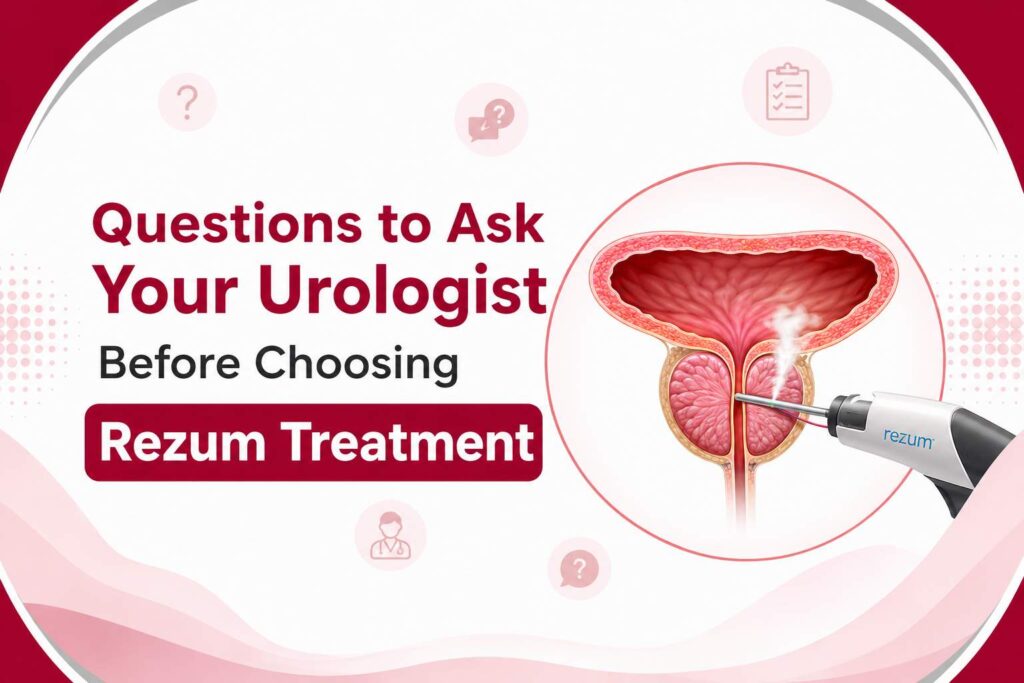
Rezum is a minimally invasive water vapor therapy designed to treat excess prostate tissue associated with BPH. The procedure uses controlled doses of steam to heat targeted prostate tissue, which is then gradually absorbed by the body.
Before making a decision, it is useful to understand your diagnosis, treatment goals, prostate anatomy, expected recovery, possible side effects, and available alternatives.
Why Should You Ask Questions Before Choosing Rezum Treatment
A BPH treatment decision should not be based only on the fact that a procedure is minimally invasive. Every patient has different symptoms, prostate characteristics, medical history, treatment goals, and expectations.
The first step is understanding exactly why treatment is being recommended.
Your urologist may evaluate factors such as:
- Severity of urinary symptoms
- Prostate size and shape
- Degree of bladder outlet obstruction
- Presence of a median lobe
- Previous BPH treatments
- Current medications
- Urinary retention history
- Bladder function
- Overall health
- Personal treatment priorities
Having a prepared list of Questions to Ask Your Urologist Before Choosing Rezum Treatment can help you avoid making a decision based on incomplete information.
It also gives you an opportunity to understand what the procedure can realistically accomplish.
Is Rezum Treatment Appropriate for My Prostate Size and Anatomy
One of the most important Questions to Ask Your Urologist Before Choosing Rezum Treatment is whether your prostate anatomy is suitable.
Prostate size is an important consideration, but it is not the only factor. The location of the obstructing tissue and the presence of a median lobe or central-zone enlargement can also influence treatment planning.
The FDA’s current documentation indicates that the Rezum System is indicated for men aged 50 years and older with prostate volumes from 30 cm³ to 150 cm³, including certain prostates with central-zone or median-lobe hyperplasia.
Ask your urologist:
- What is my prostate volume?
- Where is the obstructing tissue located?
- Do I have a median lobe?
- Is my prostate anatomy suitable for Rezum?
- Would another treatment be more appropriate?
- How many steam injections might be required?
Understanding these details can help you compare Rezum with other BPH procedures more meaningfully.
What Tests Do I Need Before Rezum
Another important question concerns the evaluation required before treatment.
A urologist may use several assessments to understand the cause and severity of urinary symptoms. Depending on the individual case, evaluation can include medical history, symptom questionnaires, physical examination, urine testing, prostate assessment, PSA testing when appropriate, uroflowmetry, post-void residual measurement, ultrasound, cystoscopy, or other investigations.
Ask:
- Do I need a urine test?
- Should my PSA level be checked?
- Do I need an ultrasound?
- Should my bladder function be evaluated?
- Is cystoscopy necessary?
- How much urine remains in my bladder after urination?
- Is there evidence of significant obstruction?
A proper evaluation can help ensure that treatment is directed at the correct cause of symptoms.
How Does Rezum Treatment Work
Understanding how the treatment works is one of the most useful Questions to Ask Your Urologist Before Choosing Rezum Treatment.
During Rezum therapy, a specialized delivery device is introduced through the urethra to reach the prostate. Controlled water vapor is delivered into targeted prostate tissue.
The thermal energy damages the selected tissue, and the body gradually absorbs the treated tissue over time. This can create more space around the urethra and improve urinary flow.
It is important to understand that symptom improvement is generally not immediate. The prostate needs time to heal and for treated tissue to be absorbed.
Ask your urologist:
- How is the treatment performed?
- How long does the procedure usually take?
- What type of anesthesia or sedation is used?
- How many treatment injections are expected?
- Will a catheter be needed afterward?
- When should I expect improvement?
Knowing the treatment timeline can help you prepare for recovery.
What Benefits Can I Reasonably Expect
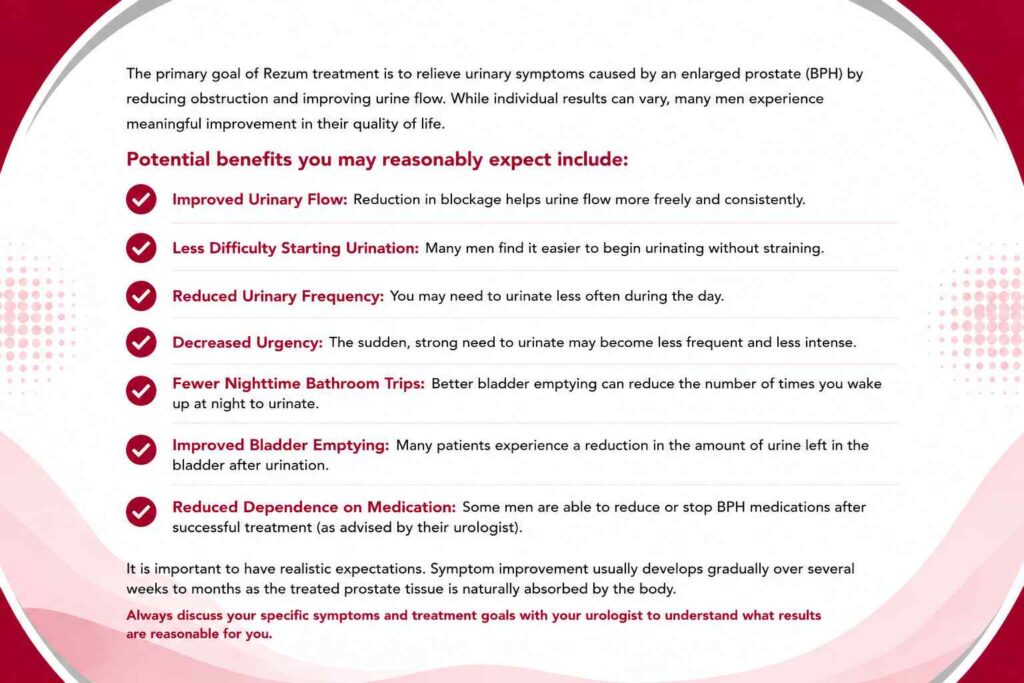
Patients often want to know whether Rezum will improve their most troublesome symptoms.
Potential benefits may include improvement in urinary obstruction and lower urinary tract symptoms associated with BPH.
Possible improvements may include:
- Better urinary flow
- Less difficulty starting urination
- Reduced urinary frequency
- Less urgency
- Fewer nighttime bathroom visits
- Improved bladder emptying
- Reduced dependence on BPH medication in some patients
However, no procedure should be presented as a guaranteed solution.
Ask:
- Which of my symptoms is Rezum expected to improve?
- How much improvement might I realistically expect?
- When should improvement begin?
- How long might it take to achieve the full benefit?
- Could I still need medication?
- How durable are the expected results?
- What happens if symptoms do not improve enough?
These questions help establish realistic expectations.
What Are the Possible Side Effects and Risks
Every medical procedure has potential risks, and understanding them is essential before treatment.
After Rezum, patients may experience temporary urinary symptoms during the healing period. These can include increased frequency, urgency, discomfort during urination, blood in the urine, or difficulty urinating.
Some patients may require temporary catheterization.
Ask:
- What side effects are most common?
- How long can temporary urinary irritation last?
- What complications should I watch for?
- How often do patients need catheterization?
- What symptoms should prompt an urgent call?
- Could treatment affect ejaculation or sexual function?
- What happens if a complication occurs?
Do not hesitate to ask for an explanation in simple language. Understanding potential risks helps you make an informed decision.
Will Rezum Affect Sexual Function
Sexual function is an important treatment consideration for many men.
When discussing Questions to Ask Your Urologist Before Choosing Rezum Treatment, include questions about ejaculation, erectile function, libido, and other aspects of sexual health that matter to you.
Different BPH treatments have different profiles regarding sexual side effects.
Ask your urologist:
- How could Rezum affect ejaculation?
- Could erectile function be affected?
- Is retrograde ejaculation a concern?
- How does Rezum compare with TURP regarding sexual function?
- How does it compare with medication?
- When can normal sexual activity usually be resumed?
A straightforward conversation before treatment can prevent uncertainty later.
How Long Does Recovery Usually Take
Recovery is another essential area to discuss.
Although Rezum is minimally invasive, it still causes controlled tissue injury inside the prostate. The body needs time to heal and remove the treated tissue.
The recovery experience can differ depending on prostate size, baseline urinary symptoms, catheter use, medications, and individual healing.
Ask:
- Will I need a catheter?
- For how long?
- Can I return home the same day?
- When can I return to work?
- When can I exercise?
- When can I drive?
- When can I resume sexual activity?
- When should urinary symptoms start improving?
Knowing what to expect can make the post-treatment period less stressful.
How Quickly Will I Notice Results
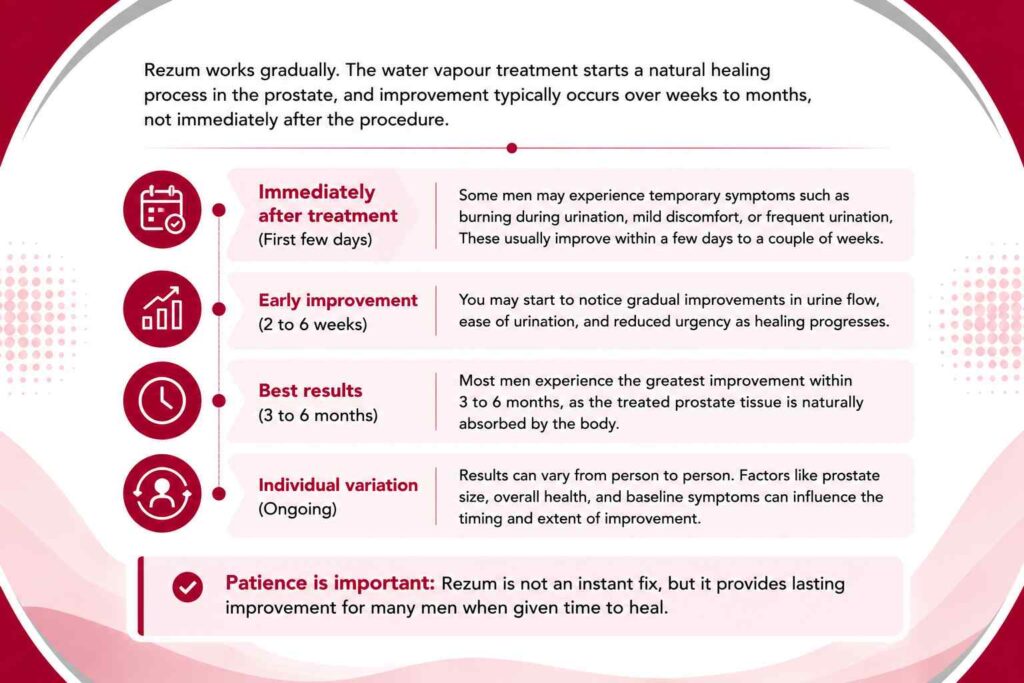
One of the most important expectations to establish before Rezum is the timing of symptom improvement.
Unlike procedures that immediately remove obstructing prostate tissue, Rezum relies on the body’s healing process. Treated tissue is gradually absorbed, so improvement may develop over time rather than immediately after the procedure.
Ask:
- When might I first notice improvement?
- When are results usually assessed?
- Can symptoms temporarily become worse?
- How long can urinary irritation continue?
- When will we know whether the treatment worked sufficiently?
Understanding this timeline can prevent patients from assuming that early postoperative symptoms mean the procedure has failed.
Should I Continue My BPH Medication
Some men considering Rezum are already taking medications for BPH.
Do not stop, reduce, or change prescribed medication without discussing it with your healthcare professional.
Ask:
- Should I continue my current BPH medication before treatment?
- Should I continue it after treatment?
- When might medication be reduced or stopped?
- What happens if symptoms return after stopping medication?
The answer can depend on your symptoms, prostate characteristics, recovery, and treatment response.
How Does Rezum Compare With Other BPH Treatments
One of the most valuable Questions to Ask Your Urologist Before Choosing Rezum Treatment is whether Rezum is actually the best option for you.
BPH can be managed through several approaches, depending on symptom severity and individual circumstances.
Potential options include:
- Watchful waiting for selected patients
- Prescription medications
- Water vapor thermal therapy
- TURP
- Laser prostate procedures
- Other minimally invasive BPH procedures
- Surgical prostate procedures for selected cases
Ask your urologist to compare the options based on:
- Prostate size
- Symptom severity
- Urinary obstruction
- Recovery time
- Sexual side effects
- Long-term effectiveness
- Retreatment possibility
- Personal treatment goals
The best treatment is not necessarily the newest or least invasive treatment. It is the option that appropriately addresses the patient’s clinical needs and priorities.
What Happens If Rezum Does Not Provide Enough Improvement
Another useful question is what the next step would be if symptoms remain bothersome.
No treatment guarantees complete symptom resolution. Persistent symptoms may occur because of prostate anatomy, bladder dysfunction, incomplete response, another urinary condition, or other factors.
Ask:
- How will my response be evaluated?
- When will you determine whether treatment was successful?
- What happens if symptoms remain?
- Could I need another procedure?
- Could medication still be required?
- What alternative treatment would be considered afterward?
Knowing the backup plan can make the treatment decision more comfortable.
What Should I Do Before Rezum Treatment
Preparation can depend on your health, medications, and the type of anesthesia or sedation planned.
Your urologist may provide specific instructions regarding medications, food and drink, transportation, and activity restrictions.
Before treatment, ask:
- Which medications should I take on the day of treatment?
- Should any medication be temporarily stopped?
- Do I need someone to accompany me?
- Should I arrange transportation home?
- What should I eat or drink before the procedure?
- Should I arrange time away from work?
- What supplies should I have available at home?
Follow the instructions provided by your healthcare team rather than relying on general online recommendations.
What Should I Ask About the Treatment Experience
Knowing what happens on the day of treatment can reduce anxiety.
Ask your urologist to explain the process from arrival through discharge.
Useful questions include:
- How long should I expect to be at the facility?
- What type of anesthesia will be used?
- Will I be awake during the procedure?
- How is discomfort managed?
- Will a catheter be inserted?
- What should I expect immediately afterward?
- Who should I contact if I have concerns after going home?
A clear explanation of the treatment pathway can help you prepare physically and mentally.
What Follow-Up Will I Need After Rezum
Follow-up is an important part of BPH treatment.
Your urologist may schedule an appointment to evaluate urinary symptoms, bladder emptying, medication use, catheter status, and overall recovery.
Ask:
- When is my first follow-up appointment?
- Will urinary flow be measured?
- Will my residual urine be checked?
- When will treatment response be assessed?
- How long will I need follow-up?
- What symptoms should I report between appointments?
Follow-up allows your healthcare team to identify problems and assess whether symptoms are improving as expected.
What Are the Most Important Questions to Bring to Your Appointment
If you want to keep your consultation focused, write down your questions before the appointment.
A practical checklist could include:
- Am I definitely experiencing BPH-related obstruction?
- Is Rezum suitable for my prostate size?
- Do I have a median lobe?
- What tests do I need before treatment?
- What results should I realistically expect?
- What are the main risks?
- Could my sexual function be affected?
- Will I need a catheter?
- How long is recovery?
- When should symptoms improve?
- How does Rezum compare with other options?
- What happens if Rezum does not work sufficiently?
- What follow-up will I need?
Taking notes during the consultation can also help you remember important details when comparing treatment options later.
Tips for Making an Informed Rezum Decision
Preparing Questions to Ask Your Urologist Before Choosing Rezum Treatment is only one part of making an informed decision.
Consider these practical tips:
- Understand your diagnosis before discussing procedures.
- Ask about your prostate volume and anatomy.
- Discuss your most bothersome symptoms.
- Tell your urologist what treatment outcomes matter most to you.
- Ask about both short-term and long-term expectations.
- Understand potential side effects.
- Ask about recovery and catheter use.
- Compare appropriate alternatives.
- Discuss medication before changing anything.
- Ask how treatment success will be measured.
- Understand what happens if symptoms persist.
- Take enough time to make a decision you are comfortable with.
Avoid choosing a treatment based solely on advertising claims, online testimonials, or comparisons that do not consider your individual anatomy and medical history.
When Should You Seek Further Medical Advice
BPH symptoms can range from mild inconvenience to significant urinary obstruction.
Symptoms may include:
- Frequent urination
- Urgency
- Weak urinary stream
- Difficulty starting urination
- Dribbling
- Getting up repeatedly at night to urinate
- Feeling that the bladder has not completely emptied
Some urinary problems can have causes other than BPH. That is why evaluation by an appropriate healthcare professional is important before selecting treatment.
If you experience severe difficulty urinating or are unable to urinate, seek prompt medical attention rather than attempting to manage the problem yourself.
Conclusion
Preparing Questions to Ask Your Urologist Before Choosing Rezum Treatment can make your consultation more informative and help you understand whether water vapor therapy is appropriate for your BPH symptoms.
The most important areas to discuss include prostate size and anatomy, diagnostic testing, expected benefits, risks, sexual function, catheter use, recovery, symptom improvement, medication, follow-up, and alternative treatments.
Rezum can be an option for appropriately selected patients with BPH, but treatment decisions should be individualized.
A well-prepared consultation helps you move beyond simply asking whether Rezum is available and instead understand whether it is suitable for your particular needs. For patients considering treatment in Thrissur, discussing these questions directly with a qualified urologist can help support a more informed and realistic treatment decision. For detailed information about the Rezum procedure, expected results, recovery, risks, and questions to discuss with your urologist, visit the Cleveland Clinic – Rezūm Water Vapor Therapy guide.