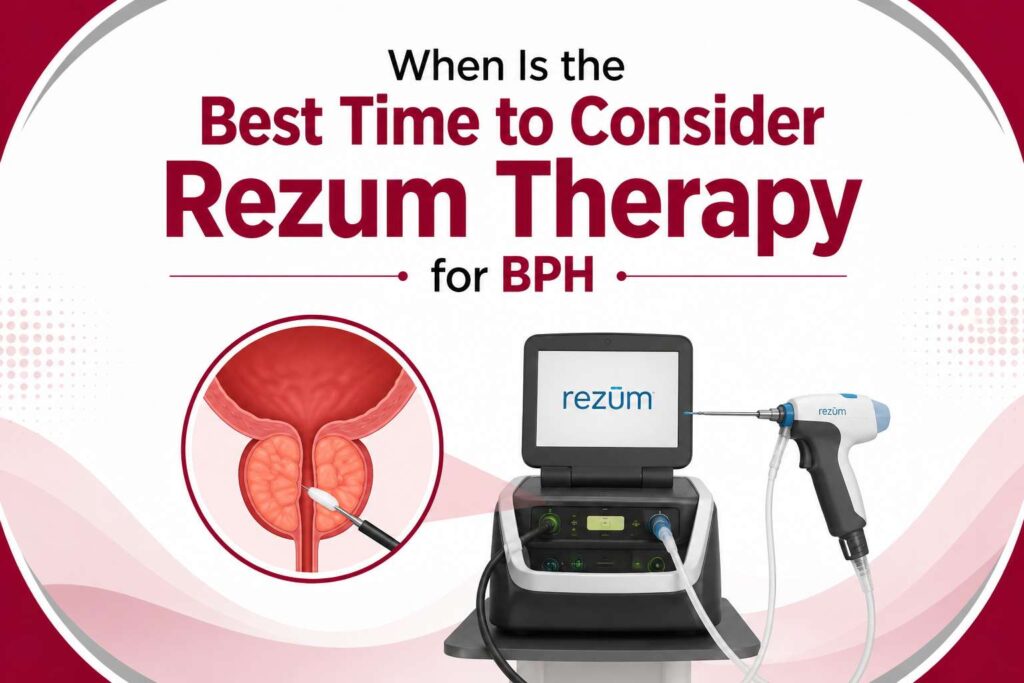
7 Powerful Reasons to Consider Rezum Therapy for BPH Relief
Benign prostatic hyperplasia (BPH) can gradually make urination more difficult, disrupt sleep, and affect everyday comfort. For men looking for an alternative to long-term medication or more invasive surgery, Rezum Therapy for BPH may be an option worth discussing with a qualified urologist. Rezum Water Vapor Therapy is a minimally invasive treatment that uses steam to target excess prostate tissue contributing to urinary obstruction. The treated tissue gradually shrinks, helping improve urinary flow and BPH symptoms over time. The American Urological Association recognizes water vapor thermal therapy as a treatment option for appropriately selected men with bothersome lower urinary tract symptoms associated with BPH.
The decision, however, should not be based on age or symptoms alone. Prostate size, symptom severity, treatment goals, previous treatments, urinary function, and overall health all need to be considered.
What Is Rezum Therapy for BPH
Rezum Therapy for BPH is a minimally invasive treatment designed to reduce excess prostate tissue responsible for urinary obstruction. During the procedure, controlled doses of water vapor are delivered into targeted areas of the prostate.
The thermal energy causes cellular damage in the treated tissue. Over time, the body naturally processes and removes the damaged tissue, reducing the amount of prostate tissue pressing against the urethra.
This can help improve the flow of urine and reduce bothersome lower urinary tract symptoms.
Unlike procedures that mechanically remove a large amount of prostate tissue, Rezum uses targeted thermal energy. This makes it an important option within the broader category of minimally invasive BPH treatments.
The treatment is intended for appropriately selected patients rather than every man with an enlarged prostate. Current manufacturer information indicates that Rezum is indicated for men aged 50 or older with prostate volumes between 30 and 80 cm³, including certain cases involving a median lobe or central-zone hyperplasia.
Why Does BPH Develop
Before considering Rezum Therapy for BPH, it is helpful to understand what causes BPH.
Benign prostatic hyperplasia is a non-cancerous enlargement of the prostate. The prostate surrounds part of the urethra, the tube that carries urine from the bladder out of the body. As prostate tissue grows, it can narrow the urethral passage and interfere with normal urine flow.
BPH becomes increasingly common with aging. Hormonal changes and changes in prostate-cell growth are believed to contribute to prostate enlargement.
Common factors associated with BPH include:
- Increasing age
- Changes in hormone balance
- Family history
- Prostate tissue growth over time
- Metabolic and cardiovascular factors
- Lifestyle factors that may influence urinary symptoms
BPH is not prostate cancer. However, urinary symptoms should still be evaluated because similar symptoms can occur with other urinary or prostate conditions.
What Symptoms Suggest It May Be Time to Consider Treatment
The best time to consider Rezum Therapy for BPH is not determined by one specific symptom. Instead, the overall effect of BPH on urinary function and quality of life matters.
Common BPH symptoms include:
- Weak urine stream
- Difficulty starting urination
- Frequent urination
- Urinary urgency
- Waking several times at night to urinate
- Intermittent urine flow
- Straining to urinate
- Dribbling after urination
- Feeling that the bladder has not completely emptied
NIDDK notes that BPH can cause problems such as frequent urination, urgency, weak urinary flow, and nighttime urination.
Mild symptoms do not necessarily require a procedure. Some men can manage early symptoms through monitoring, lifestyle changes, or medication.
However, if symptoms become persistent, increasingly bothersome, or interfere with sleep, work, travel, relationships, or daily activities, it may be appropriate to discuss procedural treatment options.
When Symptoms Become Difficult to Manage
A useful question is not simply, “How enlarged is my prostate?”
Instead, ask:
“How much are my urinary symptoms affecting my quality of life?”
A man with moderate prostate enlargement and significant symptoms may need treatment sooner than someone with a larger prostate who has minimal symptoms.
When Is the Best Time to Consider Rezum Therapy for BPH
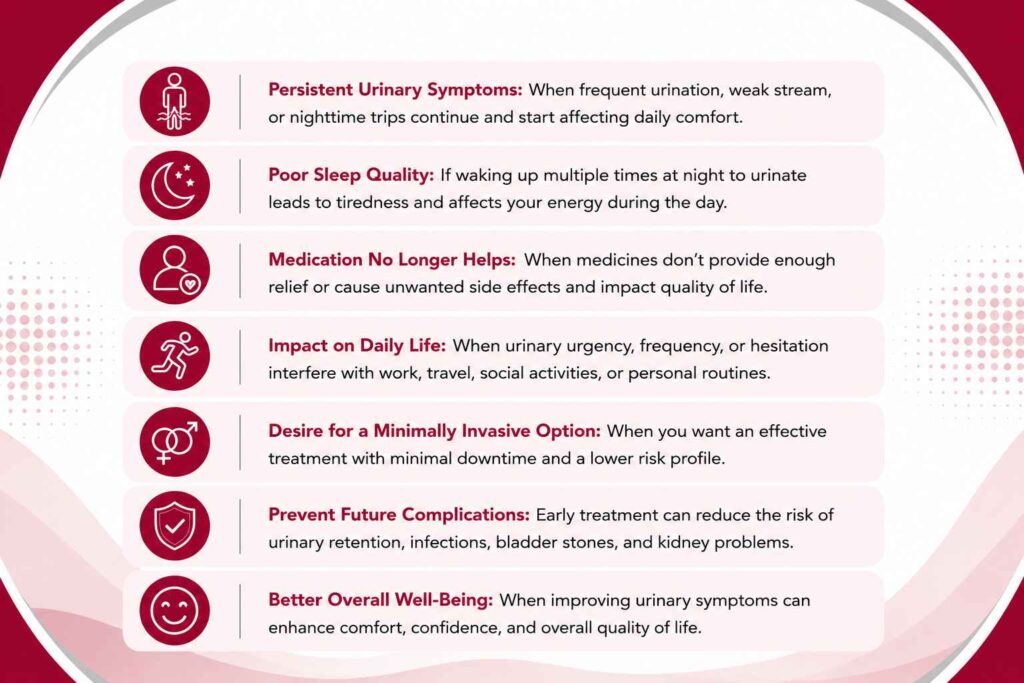
There is no universal calendar date or symptom score that determines the perfect time for Rezum Therapy for BPH.
Generally, it may be appropriate to discuss Rezum when BPH symptoms are persistent and bothersome and conservative approaches are no longer providing sufficient relief.
Potential situations include:
Symptoms Persist Despite Medication
Some men initially manage BPH with medicines such as alpha-blockers or 5-alpha-reductase inhibitors.
If medication does not provide adequate symptom control, causes unwanted effects, or becomes inconvenient as a long-term treatment, a minimally invasive procedure may be worth discussing.
Symptoms Affect Sleep
Repeated nighttime urination can result in fragmented sleep and daytime tiredness.
If nocturia becomes a consistent problem, evaluation of the underlying BPH and discussion of treatment options may be appropriate.
Urinary Flow Is Becoming Weaker
A progressively weaker stream can indicate increasing bladder outlet obstruction.
A urologist may assess urinary flow, bladder emptying, prostate size, and other factors before recommending treatment.
BPH Is Affecting Daily Activities
Some men begin planning their day around bathroom access. They may avoid long journeys, meetings, social activities, or other situations because of urinary urgency or frequency.
When BPH begins to restrict normal activities, it is reasonable to discuss whether a procedural option could improve symptoms.
You Want a Minimally Invasive Option
Men who want to avoid or delay a more invasive operation may wish to discuss minimally invasive surgical therapies such as water vapor thermal therapy.
Who May Be a Candidate for Rezum Therapy
Not every person with BPH is automatically suitable for Rezum Therapy for BPH.
Candidate selection involves a detailed evaluation.
Factors that may be considered include:
- Age
- Prostate volume
- Prostate anatomy
- Severity of urinary symptoms
- Urinary flow rate
- Post-void residual urine
- Current medications
- Previous BPH treatments
- Bladder function
- Overall health
- Treatment preferences
The Rezum system is indicated for men aged 50 years and older with prostate volumes from 30 to 80 cm³ according to the manufacturer’s current patient information.
What Evaluation Is Needed Before Rezum
Before Rezum Therapy for BPH, a healthcare professional generally needs to confirm that BPH is the likely cause of the urinary symptoms.
The assessment may include:
- Medical history
- Symptom assessment
- Physical examination
- Urine testing
- Prostate evaluation
- Prostate-specific testing when appropriate
- Measurement of post-void residual urine
- Uroflowmetry
- Prostate imaging
- Cystoscopy in selected cases
This evaluation helps determine whether the symptoms are actually caused by prostate obstruction and whether Rezum is a suitable treatment.
How Does Rezum Therapy Work
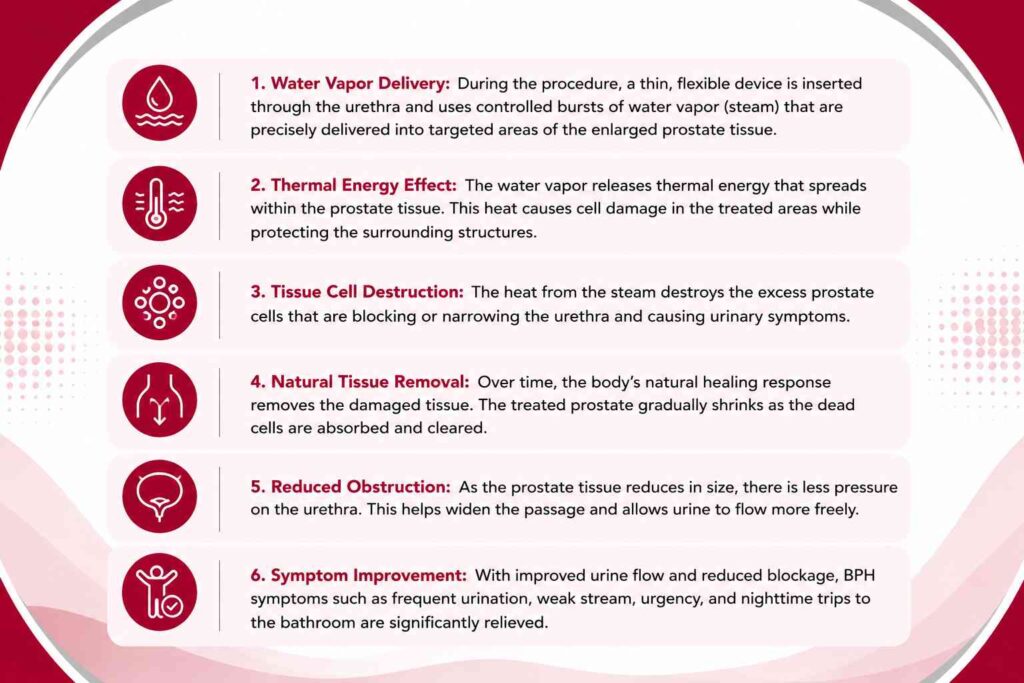
The mechanism behind Rezum Therapy for BPH is based on controlled water-vapor energy.
A specialized device delivers steam into selected areas of enlarged prostate tissue. The heat damages the targeted cells.
The body then gradually removes the treated tissue.
This process can reduce the amount of tissue obstructing the urethra and improve urinary flow.
The procedure is therefore different from approaches that physically cut out prostate tissue. NIDDK describes Rezum as transurethral water vapor therapy that uses steam to shrink an enlarged prostate.
Why Targeted Treatment Matters
The objective is not simply to make the prostate smaller.
The goal is to reduce the tissue contributing to obstruction while addressing the anatomy responsible for urinary symptoms.
This targeted approach is one reason water vapor therapy has become an important minimally invasive treatment option for selected men.
What Are the Potential Benefits
The potential benefits of Rezum Therapy for BPH depend on individual circumstances.
Possible advantages include:
- Minimally invasive treatment
- Targeted treatment of obstructive prostate tissue
- Potential improvement in urinary symptoms
- Potential improvement in urinary flow
- Reduced dependence on BPH medication for some patients
- Shorter procedural recovery compared with some traditional surgical approaches
- An option for men who want to consider preservation of sexual function
The AUA states that water vapor thermal therapy may be offered to eligible patients who desire preservation of erectile and ejaculatory function.
Clinical research has also reported sustained improvements in urinary symptoms and quality-of-life measures following water vapor thermal therapy. Long-term research has specifically evaluated preservation of sexual function after treatment.
These potential benefits should be weighed against the individual’s anatomy, expectations, and possible risks.
What Should You Expect During Recovery
Understanding recovery is important when deciding when to have Rezum Therapy for BPH.
The procedure does not immediately eliminate all prostate obstruction. The body needs time to respond to the treatment and gradually process the treated tissue.
Some men may experience temporary urinary symptoms during the healing period.
Possible short-term effects can include:
- Increased urinary frequency
- Urinary urgency
- Burning during urination
- Blood in urine
- Blood in semen
- Temporary difficulty urinating
- Urinary retention
- Discomfort
The manufacturer lists dysuria, hematuria, hematospermia, urinary frequency, urgency, retention, and suspected urinary tract infection among potential risks.
Recovery varies from person to person. Following the treatment team’s instructions regarding medications, hydration, activity, and follow-up is important.
How Does Rezum Compare With Medication
Medication remains an important first-line approach for many men with BPH.
Common medication categories include:
- Alpha-blockers
- 5-alpha-reductase inhibitors
- PDE-5 inhibitors
- Other medicines for selected urinary symptoms
Medication may be appropriate when symptoms are manageable and the individual prefers non-procedural treatment.
However, medication can require long-term use and may cause side effects in some patients.
For a man whose symptoms remain bothersome despite medication, discussing a minimally invasive procedure may be reasonable.
How Does Rezum Compare With More Invasive BPH Surgery
Traditional BPH procedures can physically remove or vaporize prostate tissue and may provide significant improvement in urinary obstruction.
Examples include:
- TURP
- Laser prostate procedures
- Laser enucleation
- Other surgical techniques
These procedures remain important options, particularly for certain prostate sizes, anatomies, or clinical situations.
Rezum is different because it uses water vapor to ablate targeted tissue rather than removing prostate tissue through conventional resection.
The most appropriate treatment depends on prostate size, anatomy, symptom severity, urinary function, medical history, and patient priorities.
There is no single BPH treatment that is best for every man.
When Should You Not Delay Medical Evaluation
While some BPH symptoms develop gradually, certain urinary problems require prompt medical assessment.
Seek medical attention if you experience:
- Inability to urinate
- Severe lower abdominal discomfort associated with urinary retention
- Significant blood in the urine
- Recurrent urinary infections
- Sudden worsening of urinary symptoms
- Fever with urinary symptoms
- Severe pain while urinating
Urinary retention can occur when urine cannot adequately leave the bladder. NIDDK notes that treatment depends on the underlying cause and may include catheterization, medication, or procedures to address obstruction.
Do not assume every urinary problem is simply BPH. Proper diagnosis is essential.
What Factors Should You Consider Before Choosing Rezum
If you are considering Rezum Therapy for BPH, discuss the following points with your urologist:
Prostate Size
The size of the prostate can influence whether Rezum is appropriate and how treatment is planned.
Prostate Shape
The location of the enlarged tissue matters. Certain prostate anatomies may require specific treatment planning.
Symptom Severity
A symptom score can help quantify the impact of BPH, but your personal experience also matters.
Medication Response
Consider whether current medication is providing sufficient relief and whether side effects are affecting your quality of life.
Sexual Function
If preservation of erectile and ejaculatory function is an important priority, discuss this before selecting a treatment.
Recovery Expectations
Ask how long symptoms may fluctuate after treatment and when improvement is expected.
Long-Term Planning
Ask about follow-up, expected symptom improvement, and the possibility of requiring additional treatment in the future.
Tips for Deciding the Right Time
There are several practical ways to prepare for a treatment discussion.
Track Your Symptoms
Keep notes about:
- How often you urinate
- How often you wake at night
- Strength of your urine stream
- Urgency
- Difficulty starting urination
- Feeling of incomplete emptying
- Impact on daily life
Review Your Current Medication
Know which BPH medications you are taking, how long you have used them, and whether they are helping.
Understand Your Prostate Measurements
Ask about your prostate volume and anatomy. These factors can help determine whether a minimally invasive procedure is appropriate.
Discuss Your Priorities
Tell your healthcare professional what matters most to you. For example, you may prioritize urinary improvement, reduced medication use, preservation of sexual function, or recovery time.
Ask About Alternatives
A good treatment decision should compare appropriate options rather than focus on one procedure in isolation.
Can Lifestyle Changes Replace Rezum Therapy
Lifestyle changes can help some men manage BPH symptoms, particularly when symptoms are mild.
Helpful strategies may include:
- Reducing fluids shortly before bedtime
- Limiting caffeine if it worsens urgency
- Limiting alcohol if it aggravates urinary symptoms
- Avoiding prolonged bladder holding
- Reviewing medications that may affect urination with a healthcare professional
- Maintaining healthy physical activity
- Managing other health conditions
NIDDK recommends measures such as adjusting fluid intake, reducing caffeine or alcohol when appropriate, and reviewing medicines that may affect bladder function.
However, lifestyle changes do not physically remove prostate obstruction.
If symptoms continue to interfere with daily life, medical evaluation may be needed.
Is Rezum an Immediate Solution
One important point when considering Rezum Therapy for BPH is that improvement is not necessarily immediate.
The treatment uses thermal energy to damage targeted prostate tissue. The body then gradually processes the treated tissue.
Therefore, patients should have realistic expectations about the recovery process.
Some urinary symptoms may temporarily become more noticeable during healing before improvement develops.
The exact timeline varies between individuals, so the treating healthcare professional should explain what is expected in a particular case.
What Are the Main Signs That Treatment Should Be Discussed
A discussion about Rezum Therapy for BPH may be appropriate when several of the following occur together:
- BPH symptoms are persistent
- Symptoms interfere with sleep
- Urinary flow has become noticeably weaker
- Medication is not providing enough relief
- Medication side effects are problematic
- Daily activities are being restricted
- There is evidence of bladder outlet obstruction
- You prefer a minimally invasive treatment
- You want to discuss options that may preserve sexual function
The decision should be individualized rather than based on one symptom.
Conclusion
The decision to consider Rezum Therapy for BPH should be based on more than prostate size alone. Persistent urinary symptoms, reduced quality of life, inadequate response to medication, treatment preferences, prostate anatomy, and overall health all have a role.
Rezum Water Vapor Therapy is a minimally invasive treatment that uses steam to target excess prostate tissue. It may be an appropriate option for selected men, particularly those seeking an alternative to long-term medication or more invasive prostate surgery.
The right timing is therefore personal. If urinary symptoms are increasingly affecting sleep, daily activities, or quality of life, it may be worthwhile to have a detailed discussion about available BPH treatments. Men researching Rezum Therapy for BPH in [INSERT LOCATION] should seek an individualized evaluation rather than choosing treatment based solely on online information. For more information about benign prostatic hyperplasia, its symptoms, diagnosis, and treatment options, visit the National Institute of Diabetes and Digestive and Kidney Diseases (NIDDK).