
How to Choose the Right BPH Treatment for Your Condition: A Practical Guide
Benign prostatic hyperplasia (BPH), commonly called an enlarged prostate, can cause urinary symptoms that range from mildly inconvenient to seriously disruptive. A weak urine stream, difficulty starting urination, frequent bathroom visits, urgency, nighttime urination, and incomplete bladder emptying can affect sleep, work, travel, and everyday comfort. However, not every man with BPH needs the same treatment.
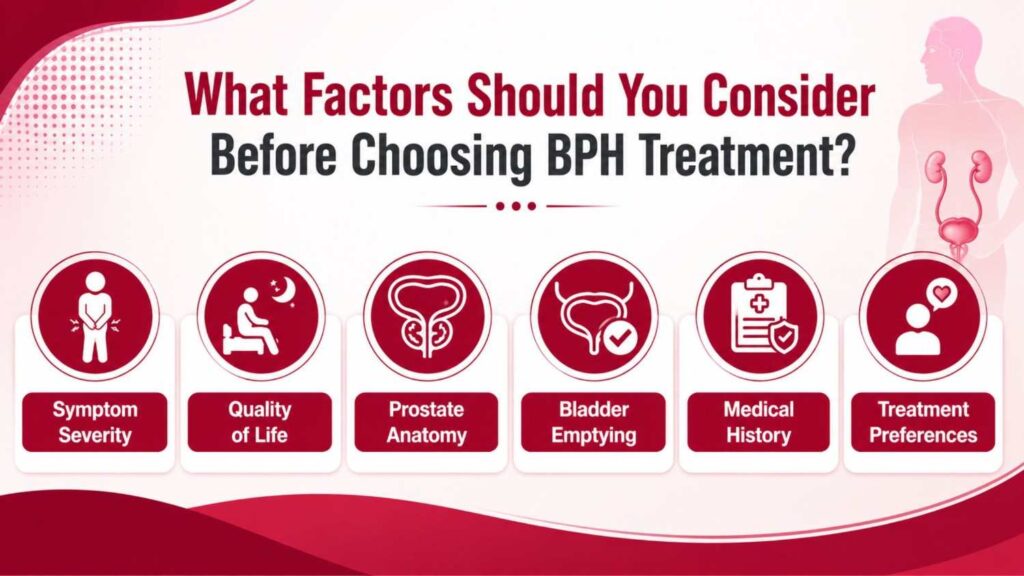
How to Choose the Right BPH Treatment for Your Condition depends on several factors rather than prostate size alone. Symptom severity, quality-of-life impact, prostate anatomy, urinary flow, bladder function, medical history, previous treatments, potential side effects, and personal treatment preferences can all influence the decision. BPH can be managed through observation, lifestyle changes, medication, minimally invasive procedures, or surgery, depending on the individual situation.
What Is BPH and Why Does Treatment Matter?
BPH occurs when the prostate becomes enlarged without the enlargement being caused by cancer. As the prostate grows, it can compress the urethra and make it harder for urine to pass from the bladder. The bladder may then have to work harder to push urine through the narrowed passage.
Common BPH symptoms include:
- Weak or interrupted urine flow
- Difficulty starting urination
- Frequent urination
- Sudden urinary urgency
- Getting up repeatedly during the night
- Dribbling after urination
- A sensation that the bladder has not emptied completely
- Difficulty maintaining a steady urinary stream
Importantly, the severity of symptoms does not always correspond directly to prostate size. A man with a relatively large prostate may have few urinary complaints, while another man with a smaller enlargement may experience significant obstruction and discomfort.
This is why choosing treatment should begin with a proper evaluation rather than assuming that a particular procedure is automatically appropriate.
How to Choose the Right BPH Treatment for Your Condition
How to Choose the Right BPH Treatment for Your Condition starts with understanding what is actually causing your symptoms and how much they affect your life.
A healthcare professional may consider your medical history, urinary symptoms, physical examination, medications, and relevant diagnostic tests. Depending on the situation, evaluation may include urinalysis, PSA testing, ultrasound, urinary flow assessment, post-void residual measurement, or other investigations.
The decision may then involve several broad treatment categories:
- Watchful waiting or active surveillance
- Lifestyle modifications
- Prescription medication
- Minimally invasive treatments
- Surgical procedures
There is no requirement to move directly from mild symptoms to surgery. Likewise, continuing medication indefinitely is not necessarily the best approach if symptoms remain bothersome or complications develop.
The right treatment is the one that matches the patient’s clinical condition and treatment priorities.
When Is Watchful Waiting Appropriate?
Not every man with BPH needs immediate treatment.
For men with mild symptoms that do not significantly affect quality of life, watchful waiting or active surveillance may be an appropriate approach. This involves regular follow-up rather than simply ignoring the condition. Lifestyle adjustments may also be recommended during this period.
Watchful waiting may include:
- Regular symptom assessment
- Periodic medical review
- Monitoring urinary function
- Adjusting fluid intake
- Reducing caffeine and alcohol
- Remaining physically active
- Reviewing medicines that may worsen urinary symptoms
The important distinction is between supervised monitoring and doing nothing.
If symptoms worsen, urinary retention develops, or complications appear, the treatment plan may need to change.
When Are Lifestyle Changes Enough?
Lifestyle measures can be useful for men with mild symptoms or as part of a broader BPH management plan.
Helpful measures may include:
Managing Fluid Timing
Reducing fluid intake before bedtime or before situations where frequent bathroom access is inconvenient may reduce urinary frequency.
Reducing Caffeine and Alcohol
Caffeine and alcohol may increase urinary frequency in some people. Reducing intake can therefore help some men manage symptoms.
Staying Physically Active
Regular physical activity supports overall health and may be beneficial for men with BPH.
Avoiding Prolonged Urine Holding
Using the bathroom regularly rather than repeatedly holding urine may help some men manage urinary symptoms.
Reviewing Medications
Certain medicines, including some decongestants, antihistamines, diuretics, and other drugs, may worsen urinary symptoms. Medication changes should always be discussed with a healthcare professional rather than made independently.
Lifestyle changes may be sufficient for some men, but persistent or worsening symptoms deserve further evaluation.
When Might Minimally Invasive Treatment Be Appropriate?
For men whose symptoms remain bothersome despite medication, or for those who prefer a procedural approach, minimally invasive treatments may be considered.
Rezum treatment is one minimally invasive option that uses controlled water vapour to treat targeted enlarged prostate tissue. The treated tissue is gradually processed by the body, which can help reduce obstruction and improve urinary flow over time.
Examples include:
- Transurethral water vapor therapy
- Prostatic urethral lift
- Other minimally invasive surgical therapies
Transurethral water vapor therapy uses controlled water vapor to treat targeted enlarged prostate tissue. The body subsequently processes the treated tissue, which can help reduce obstruction and improve urinary flow over time. NIDDK lists water vapor therapy among minimally invasive treatment options for BPH.
Minimally invasive treatment may appeal to men who want an alternative to long-term medication or more extensive tissue-removing surgery. However, suitability depends on individual prostate anatomy, symptoms, medical history, and the specific procedure being considered.
When Is Surgery Considered for BPH?
Surgery remains an important treatment option for men with severe or persistent BPH symptoms, particularly when other treatments have not provided adequate relief or complications develop.
According to NIDDK, surgery may be considered when medicines do not help, symptoms are severe or bothersome, or complications occur.
Potential reasons for considering surgery include:
- Persistent severe urinary symptoms
- Recurrent urinary retention
- Recurrent urinary tract infections
- Significant bleeding associated with BPH
- Bladder stones
- Other complications related to obstruction
- Inadequate response to less invasive treatments
Surgical options include procedures such as transurethral resection of the prostate and laser-based approaches. The appropriate procedure depends on the patient’s anatomy, symptoms, health status, and clinical circumstances.
Surgery can provide substantial symptom relief, but it also has potential risks and recovery considerations. These should be discussed before making a decision.
How Does Prostate Size Affect Treatment Selection?
Prostate size is an important consideration, but it should not be treated as the only deciding factor.
A larger prostate may require a different treatment strategy from a smaller prostate. However, prostate anatomy, the location of obstructing tissue, urinary flow, bladder emptying, and symptom severity also matter.
This is particularly relevant when considering minimally invasive procedures. Some treatments are appropriate only within particular anatomical or clinical parameters.
Therefore, How to Choose the Right BPH Treatment for Your Condition should never be reduced to a simple question such as, “How large is my prostate?”
The better question is:
What combination of prostate characteristics, urinary function, symptoms, health factors, and treatment priorities makes a particular option appropriate for me?
Why Bladder Function Matters When Choosing Treatment
The prostate is only one part of the urinary system.
When BPH causes obstruction, the bladder may need to generate greater pressure to push urine through the narrowed urethra. Over time, this can affect bladder function and contribute to incomplete emptying or urinary retention.
This is why tests such as:
- Uroflowmetry
- Post-void residual measurement
- Ultrasound
- Urodynamic testing when indicated
may contribute to treatment planning.
If a man has significant residual urine, treatment decisions may be different from those for someone who has bothersome frequency but empties the bladder effectively.
Understanding bladder function can therefore help create a more complete picture of the condition.
How Do Recovery and Personal Priorities Affect the Decision?
How to Choose the Right BPH Treatment for Your Condition also means considering what happens after treatment.
Different options have different expectations regarding:
- Recovery time
- Temporary urinary symptoms
- Catheter requirements
- Medication use
- Follow-up
- Sexual side effects
- Long-term symptom control
For example, a man who strongly wants to avoid daily medication may consider a procedural option. Another man may prefer medication because he wants to avoid a procedure.
Neither preference is automatically right or wrong.
The decision should be based on a realistic discussion of benefits, risks, limitations, and expected recovery.
Common Mistakes to Avoid When Choosing BPH Treatment
Choosing Treatment Based Only on Prostate Size
Size matters, but it does not tell the entire story.
Assuming Surgery Is Always the Best Solution
Surgery can be highly effective, but it is not automatically necessary for every man with BPH.
Assuming Medication Is Always the Safest Long-Term Choice
Medication can be appropriate, but side effects, effectiveness, and long-term treatment preferences should be considered.
Comparing Treatments Without Considering Anatomy
A procedure that is suitable for one prostate configuration may not be appropriate for another.
Ignoring Bladder Function
Incomplete bladder emptying can be clinically important and should not be overlooked.
Waiting Until Symptoms Become Severe
Delaying evaluation can make treatment decisions more difficult, particularly when significant obstruction or complications develop.
Choosing Based on Someone Else’s Experience
A friend’s experience with BPH treatment does not determine which option is appropriate for you.
Focusing Only on Immediate Results
Treatment decisions should consider both short-term recovery and long-term symptom management.
Conclusion
How to Choose the Right BPH Treatment for Your Condition is not a decision that should be based on prostate size, age, or another person’s treatment experience alone.
BPH treatment can range from watchful waiting and lifestyle changes to medication, minimally invasive procedures, and surgery. The right option depends on the combination of symptoms, quality-of-life impact, prostate anatomy, urinary flow, bladder function, medical history, previous treatment, and personal priorities.
For some men, monitoring and lifestyle changes may be enough. Others may benefit from medication. When symptoms remain bothersome, minimally invasive procedures may provide another treatment pathway. Surgery may become appropriate when symptoms are severe, other treatments are unsuccessful, or complications develop. For a broader overview of evidence-based recommendations, the BPH treatment options and guidelines from the American Urological Association can provide additional clinical context.